Areas · Leverington and Wisbech St Mary
Roofers in Leverington and Wisbech St Mary
Roofers in Leverington and Wisbech St Mary are quoting two Fenland villages either side of the town, where the useful question is whether your address belongs to the old core or to the later building around it.
Two villages, and in each of them two different jobs
Leverington is a village and civil parish in the Fenland district of Cambridgeshire, immediately north of Wisbech, with 3,339 residents at the 2011 census. Wisbech St Mary is a village and civil parish in the same district two miles west of the town, with 3,556 residents at the same census, and its parish also takes in Murrow, Guyhirn and Thorney Toll.
Both are Fenland District Council territory, so unlike some places around Wisbech there is no argument about which authority you deal with. The question that matters here is the one almost every Fenland village poses: does your address belong to the historic core of the village or to the later building that grew around it? The answer decides what may go back on the roof, and getting it after you have ordered materials is the expensive way round.
Leverington has a designated conservation area of its own
This is a specific fact with consequences rather than a general observation. Fenland District Council has published a Leverington Conservation Area Appraisal, which means Leverington is one of the 10 conservation areas the district holds. If you live in the village, that document is worth ten minutes before you spend thousands on a roof.
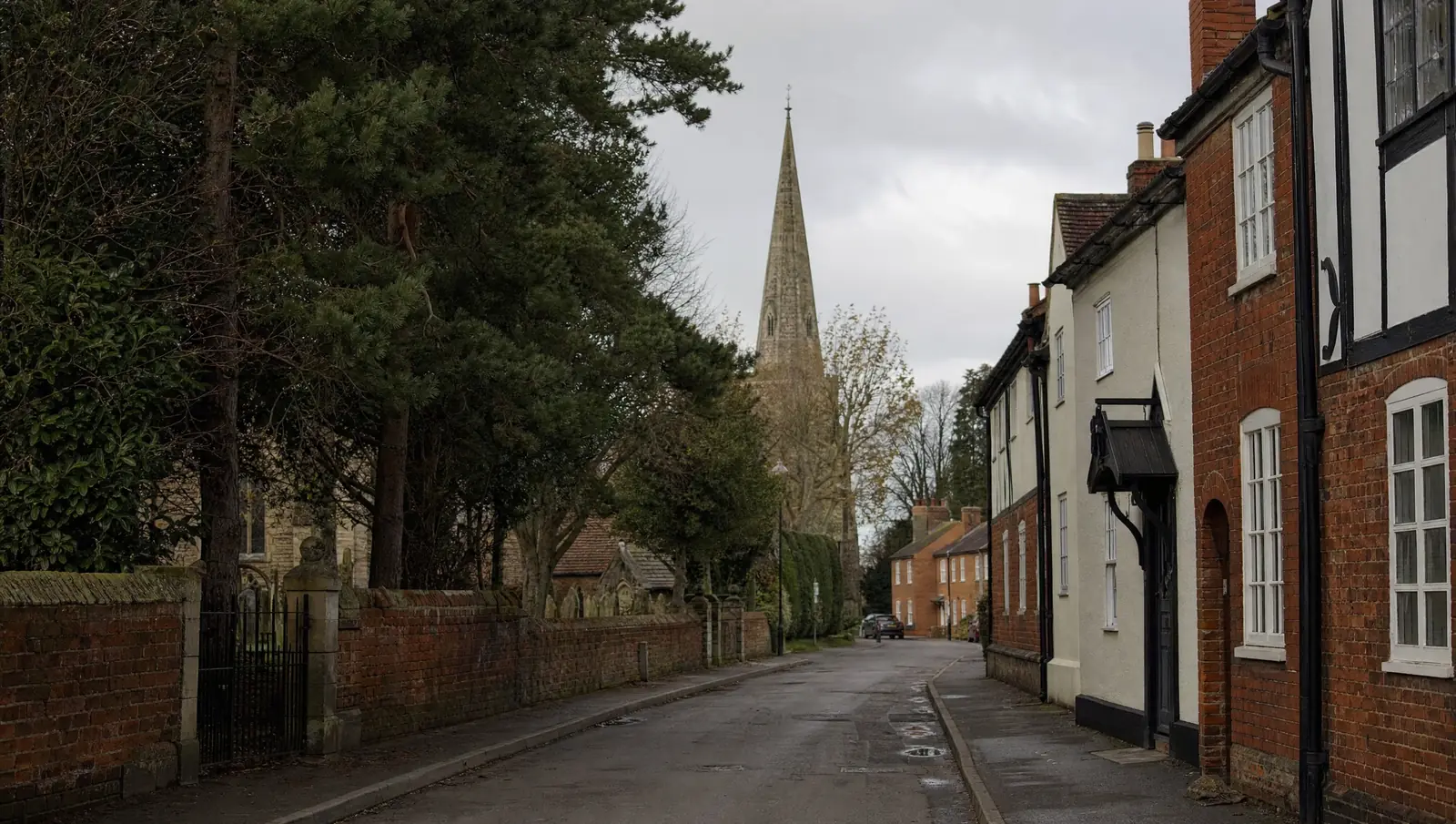
The village also carries substantial protected fabric. St Leonard's Church is Grade I listed and noted for its spire, Leverington Hall is a Grade I listed seventeenth century country house, Park House is Grade II and dates from about 1720, and Malvern House is Grade II and was built around 1840.
Inside a designated boundary, Fenland has extra control over demolition, trees, development and minor alterations, its own examples of the last being cladding a building, inserting dormers and attaching satellite dishes. Outside it, a like-for-like recovering on an unlisted house normally falls within permitted development. Same village, two different jobs. The general position is in our listed buildings and conservation areas guide.
Wisbech St Mary is one parish name covering several places
The parish takes in Murrow, Guyhirn and Thorney Toll as well as the village, so a single name stretches across separate settlements on open fen some distance apart. Telling a firm you are in Wisbech St Mary conveys almost nothing about how far they are travelling or what the access looks like. Give the postcode and a landmark, not the parish.
The Church of St Mary is Grade II* listed, perpendicular in style, with restorations recorded in 1894 and 1901. Beyond that we have not sourced a conservation area designation for Wisbech St Mary, and we are not going to assume one either way to round the page off neatly. Check your own address with Fenland rather than taking a roofer's word for it, or ours. On the practical side, both villages sit far enough out that access and scaffold shape the quote, which is dealt with on Elm and Emneth.
Old core or later edge? What each answer changes
| The question | In the old core | On the later edge |
|---|---|---|
| What can go back on the roof | Expect to match in material and appearance | Your choice, subject to pitch, structure and building regulations |
| Whether you need consent first | Possibly, and it is a question for Fenland before you buy anything | Usually not for a like-for-like recovering |
| Ridge and verge detailing | A modern dry system may not suit where the existing detail is part of the character | Dry ridge and dry verge are normal, and beat mortar in wind |
| Rooflights, dormers and dishes | Controlled. Fenland names dormers and dishes among its own examples | Permitted development limits apply instead |
| Who should be quoting | A firm that has done conservation area work and will talk to a conservation officer | Any competent pitched roofing firm covering the postcode |
| What it does to the price | Sits outside our guide ranges, mostly on materials and the front end | Inside the guide ranges for ordinary domestic work |
Guide ranges are on roofing costs. If the building is listed, neither column applies cleanly and the position is individual to that building.
Settle the specification before the materials are ordered
The costly mistake here is not choosing the wrong covering. It is choosing late. Once a delivery is booked and a start date is in the diary, everybody has an incentive to press on, and that is when people accept an answer nobody has checked. Get six things in writing first.
- The covering named by manufacturer and product, not by category
- How the ridge and verges will be finished, and why
- What happens to the underlay and battens
- A stated rate for replacing rotten timber found on strip
- Who obtains any consent, and at whose cost
- What happens to the programme and price if the council is slow
To establish the conservation area position for your address, the step-by-step method is on Waterlees and Clarkson and works identically in a village. If you are wondering whether you are even in Fenland, that is the Walsoken question, and the Brinks and town centre covers the listed core.
For the work see tiling and slating and chimney repairs. If a leak brought you here, roof leaks explains why the damp patch is rarely under the hole. When you are ready, compare quotes.
Frequently asked questions
Almost certainly not, and that is the normal pattern. A conservation area is a drawn boundary, and in a village it usually follows the historic core rather than everything sharing the name. Fenland has published a Leverington Conservation Area Appraisal, so the boundary is documented.
Listing is recorded on the national list, searchable by address, and it is a separate exercise from checking a conservation area boundary. Leverington has Grade I fabric at St Leonard's Church and Leverington Hall, and Grade II buildings including Park House from about 1720, which is reason enough to check rather than assume.
Sometimes, and it is a fair question, but it is not purely aesthetic. Changing the covering changes the loading, the batten gauge and sometimes the minimum pitch, so the roofer needs to assess the structure and put the proposal in writing. Inside a conservation area it becomes a planning question as well.
We have not sourced a designation for it and we are not going to state one either way, because a wrong answer here costs you real money. Fenland District Council publishes its conservation areas and holds the boundaries. Ask them about your specific address and keep the reply.
The ones that apply at your building, which is why the parish name is not a useful guide. The parish also takes in Murrow, Guyhirn and Thorney Toll, so a parish address can be several miles from the village centre. Conservation area boundaries are tight and local.
More than you would expect. An appraisal sets out what the council thinks gives the area its character, and roof form, covering and detailing are usually part of that. Reading it first tells you what an officer is likely to care about.
Get quotes from Wisbech roofers
Tell us your postcode and what needs doing. We pass it to vetted roofing firms covering that part of Wisbech, and they come back to you directly with quotes.
- Takes about a minute
- No cost to you, ever
- You choose who to speak to, and you can say no to all of them
Compare Wisbech roofers
Answer four questions. We pass your job to vetted roofers who cover your postcode, and they come back to you with quotes. No charge, no obligation.
We pass your details only to roofing firms that cover your postcode, so they can quote. We never sell your details on for other purposes. See our privacy notice.
Find out what your roof should cost
Compare quotes from vetted Wisbech roofers, or call us and we will point you at the right sort of firm for the job.