Costs · updated July 2026
Roof repair cost in Wisbech
Roof repair cost in Wisbech, job by job, with the call-out charge, what access adds on an exposed site, and the point at which repairing stops adding up.
Guide ranges, not quotes
Every number here is a researched guide range for the Wisbech area as at July 2026, including VAT. None of it is an offer or a quotation and no roofing firm is bound by it.
This site is not a roofing contractor. It is a free quote-comparison service operated by Expert Roofers, so nothing here gains from talking a price up. The firms we introduce you to will price your actual roof.
The commonest mistake is assuming a roof repair runs into thousands and putting it off on that basis. Most do not. A pantile put back this autumn is a couple of hundred pounds. The same pantile found in three years, after the membrane beneath it has been soaked every winter and the batten ends have gone soft, is a different conversation with a different number.
Roofing is one of the few trades where waiting multiplies the bill rather than simply postponing it, and on an exposed site the multiplier is bigger. One loose tile on a sheltered street stays one loose tile. One loose tile on an open gable beside the fen is the gap the wind needs.
Roof repair prices in Wisbech, job by job
| Repair | Typical guide range | What moves it |
|---|---|---|
| Refix or replace one to three slipped tiles | £150 to £280 | Whether a ladder gets to it safely |
| Replace cracked or broken tiles across a roof | £180 to £350 | How many, and whether the profile is still made |
| Replace slipped slates on an older roof | £180 to £350 | Slate size and the state of the fixings around them |
| Re-bed and repoint a ridge in mortar | £450 to £1,100 | Ridge length and whether the tiles come off re-usable |
| Convert a mortar ridge to a dry ridge system | £650 to £1,200 | Ridge length and the tile profile underneath |
| Repair or repoint a mortar verge, one gable | £250 to £600 | Gable height and access |
| Fit a dry verge system, one gable | £350 to £750 | Run length and tile profile |
| Replace a lead valley | £450 to £1,100 | Length, lead code, and how many tiles have to come off |
| Renew lead flashing to a chimney or abutment | £350 to £850 | Size, access, and the state of the brickwork behind it |
| Replace failed felt at the eaves, one elevation | £350 to £850 | Elevation length and tiles to lift |
| Repair or sister a single rafter | £180 to £450 | Loft access and how much of it has gone |
| Trace and fix a small leak | £180 to £450 | Almost entirely how long it takes to find |
| Emergency temporary cover, tarpaulin or sheeting | £150 to £400 | Time of day, height, and how long it has to stay up |
Anything that needs a full scaffold rather than a ladder or a tower sits above these figures, and the access table below shows by how much. Chimney repointing at £600 to £1,600 is covered on the chimney repairs page, and moss removal and roof cleaning at £400 to £1,100 on the roofing costs hub. Listed buildings and property inside a conservation area sit outside every range on this page. That is not us dodging the question, and there is a section below explaining exactly what drives those costs instead.
Call-out charges and minimum job prices
Why a £3 tile costs £200 to put back
You are not paying for the tile. You are paying for two people, a van, a ladder or a tower, the insurance that allows somebody to stand on your roof at all, and the hour either side of the job that never appears on an invoice. A firm that turns out for sixty pounds is either working at a loss or is not carrying the cover it should be.
That arithmetic is why most established firms hold a minimum job charge of £150 to £250. It is also the strongest argument for bundling every small job into one visit rather than calling somebody out three times a year.
| Charge | Typical guide range | Usually waived? |
|---|---|---|
| Minimum job charge, standard hours | £150 to £250 | No. It is the floor for any visit involving work |
| Quote visit for a repair or a larger job | No charge | Standard on anything above a very small repair |
| Inspection with a written condition report | £60 to £150 | Often deducted if you go ahead with the work |
| Emergency call-out, same day, working hours | £150 to £350 | No, and the repair itself is charged on top |
| Emergency call-out, evening, weekend or bank holiday | £250 to £500 | No, and expect the top of the range after a storm |
A firm that will not explain its call-out policy on the phone has told you something useful at no cost. Ask the question first.
Access is what you are really paying for
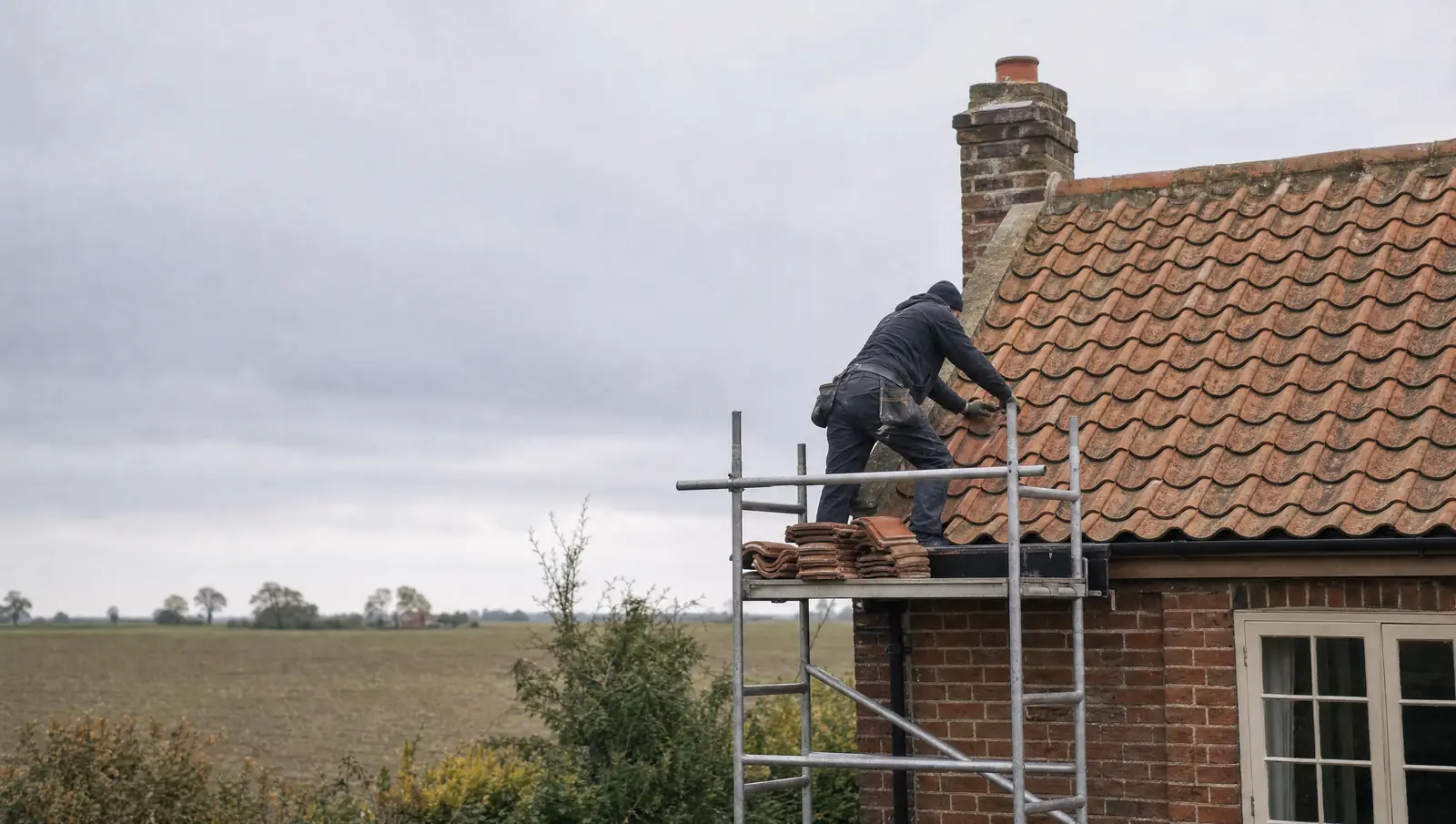
On a small repair the access equipment routinely costs more than the repair does. That single fact explains most of the cases where two honest quotes for the same job land hundreds of pounds apart, and it is the first thing to check when you are comparing them.
| Access method | Guide cost | When it is the right answer |
|---|---|---|
| Ladder only | Inside the job price | One tile near the eaves on a low roof |
| Mobile access tower | £150 to £350 for the day | One small area: a chimney base, the eaves, a length of gutter |
| Chimney or partial scaffold, one elevation | £450 to £900 | Chimney flashing, a valley, or a ridge worked from one side |
| Full scaffold, semi-detached house | £900 to £1,800 | Anything that means walking the roof |
| Full scaffold, detached house | £1,300 to £2,800 | More elevations and a longer perimeter to enclose |
| Full scaffold, terrace with no rear vehicle access | £900 to £1,900 | Everything carried in by hand, which is a lot of the older town centre |
| Powered access platform with operator | £350 to £700 per day | Restricted ground with no room to stand a scaffold |
This is why a £250 repair becomes an £1,100 job, and why you look at the whole roof before the scaffold goes up. If it is standing for two days anyway, the gutters, the flashing and the tile on the far slope should all be priced at the same time.
Scaffold in the historic core is its own problem. Narrow frontages, a pavement immediately against the wall and no rear vehicle access all push the figure towards the top of the terrace band, and on some streets there is a licence to arrange before anything is erected. See the Brinks and town centre. On the post-war estates and out in the villages, open frontages and drive access make the same scaffold considerably cheaper.
Repair or replace, with actual numbers
Every roofing site says repairs eventually stop making sense. Almost none of them says where the line is, because the line sits inconveniently far in favour of repairing.
Here is the test. Take what replacing the roof would cost and divide it by the realistic life of the new one. A concrete interlocking re-roof on a semi here is £7,000 to £10,000 and should give 40 to 60 years, so it costs £120 to £250 a year. A clay pantile re-roof on the same house is £9,000 to £13,000 over 60 years or more, so £150 to £215 a year. If you are spending more than that on repairs every year, on a covering whose remaining life nobody will put in writing, the repairs have lost the argument.
Two things override the arithmetic. If the covering is under thirty years old and the problem is in one place, repairing almost always wins. And if you are selling within two years a re-roof rarely returns its cost, though an unresolved leak certainly costs you at survey.
| Situation | Usually the answer | Rough cost of that answer |
|---|---|---|
| One or two slipped tiles, covering under thirty years old | Repair | £150 to £350 |
| Mortar ridge failing but the tiles themselves are sound | Repair, and convert to dry ridge | £650 to £1,200 |
| Mortar verge crumbling on the windward gable | Repair, and convert to dry verge | £350 to £750 |
| One valley or one chimney flashing letting water in | Repair | £350 to £1,100 |
| Different repairs in different places, three years running | Replace | £7,000 to £10,000 on a semi in concrete tile |
| Slates or pantiles slipping everywhere, fixings corroded | Replace | £9,000 to £13,000 on a semi in clay pantile or slate |
| Tiles breaking underfoot when a roofer walks the roof | Replace | As above, and stop paying for repairs now |
| Underlay brittle or torn in strips, visible from the loft | Replace, or strip and re-lay | £5,500 to £9,000 on a semi |
| Selling within two years, tired but not leaking | Repair what leaks and disclose the rest | £150 to £1,200 |
The strip and re-lay figure sits below the full re-roof range because the covering, about 14 per cent of the bill, is the one cost you avoid. It only works where the tiles come off intact. There is a full breakdown on new roof cost.
Wind damage, and what your insurance will actually pay for
Buildings insurance covers storm damage. It does not cover wear and tear, gradual deterioration or a roof at the end of its life, and nearly every declined claim lives in that gap. The test is whether a specific weather event damaged a roof that was in reasonable condition beforehand. A tile lifted off in a gale is a claim. Twenty tiles that had been slipping for five years and finally let go is not.
That distinction bites harder here than inland. Flat, open fen with a tidal river through it makes wind damage a common cause of loss rather than a freak event, and it also means an insurer looks hard at whether the roof was maintained. A ridge visibly open at the mortar joints for years will not be treated as storm damage just because a storm finished it off.
When a claim is worth making
Most policies carry an excess of £250 to £500, which rules out claiming on an ordinary repair before you start, and a claim sits on your history for years. As a guide, a bill under about £1,000 is not worth claiming, one over £1,500 usually is, and in between it depends on your excess and when you last claimed.
- Photograph everything before anything beyond making safe is touched, including from inside the loft.
- Get the roof made safe regardless. Temporary cover is normally paid for even where the eventual repair is argued about.
- Keep the invoice for the temporary cover, and keep the damaged materials.
- Ask for a short written opinion on the cause. Insurers take a competent roofer's report seriously.
- Check whether the policy requires the insurer's own contractor, before the work rather than after it.
None of that changes what the work costs, only who pays for it. Price the repair properly either way, because a claim settled on the insurer's figure does not help you if the figure was wrong. There is more on the first hour after a storm, and on the trader who knocks the next morning, in the storm damage guide.
What actually breaks on Wisbech roofs
Three patterns cover most of the repair work in this district, and they map onto three quite different sorts of building.
Edges, on almost everything
The town sits on flat, open fen beside the tidal Nene with nothing upwind. Roofs here do not usually fail in the middle of a slope, they fail at the ridge, the verge and the eaves, which is where uplift is concentrated. So the repeat callers are mortar ridges opening up, mortar verges crumbling on the windward gable, and underlay torn at the eaves where nothing was supporting it.
That is the argument for converting to dry fixed systems rather than repointing again. A dry ridge conversion at £650 to £1,200 costs more today than a repoint at £450 to £1,100, and it stops you buying the same repair again in eight years.
The historic core
Along the Brinks and around the Old Market, the Market Place and The Crescent, the roofs are older, the details are more complicated and a great many of the buildings are listed. Parapets, secret gutters, hidden valleys and heavy leadwork are normal, and the failure is usually in the lead or the gutter rather than in the covering. None of it is priced by the ranges on this page. See listed buildings and conservation areas first.
The estates and the villages
Post-war and later housing across Waterlees, Clarkson, Walsoken and out through Elm, Emneth, Leverington and Wisbech St Mary is mostly concrete interlocking tile on mortar bedded ridges and verges. Those roofs are now at the age where the bedding goes and the nails corrode, so tiles slip because the fixings have gone rather than because the tiles have. For the work rather than the price see roof repairs, read how to choose a roofer, then compare quotes from firms that cover your postcode.
Frequently asked questions
For anything likely to turn into a real job, yes, and that quote visit is normally free. What is not free is a diagnostic visit with a written report and no work attached, typically £60 to £150 and often deducted if you go ahead.
If somebody offers a free inspection unprompted at your door, that is a sales visit rather than a survey.
Temporary cover can go on in almost any weather, and should. Most permanent repairs cannot: mortar will not cure, adhesives will not bond and nobody should be standing on a wet pitched roof.
Wind is the bigger constraint here. A firm that would rather wait two days for it to drop is protecting both its people and your roof.
Hold it against the job table above, then ask what access is included. Most quotes that look high are carrying a tower or a scaffold that the cheap quote assumed a ladder would cover.
Then ask what happens if it turns out bigger than expected. A good answer is a stated rate and a phone call before anybody proceeds.
On an exposed site, converting usually wins. Repointing at £450 to £1,100 restores the ridge to the condition it was in before it failed, which on this ground lasted perhaps eight to fifteen years.
A dry ridge system at £650 to £1,200 is mechanically fixed and ventilated, and does not depend on mortar surviving wind and frost. If the access is going up either way, the extra is small.
Often, yes. The tiles on a 1970s concrete roof frequently have life left. What is usually finished is the felt beneath, the mortar bedding and the nails, and those can be dealt with in sections.
It stops being worth it when a roofer cannot walk the roof without breaking tiles, or when you are paying for a different repair somewhere new each year.
A roof where the nails holding the slates or tiles have corroded away. The coverings themselves can be sound and still slide off, a few at a time, from all over the roof.
It is the clearest signal that individual repairs have stopped being economic, because you pay access costs again and again for a problem that is everywhere at once.
You own your section, and the boundary normally runs along the party wall. Shared elements such as a party chimney stack or a shared valley are usually a joint responsibility, which is where the arguments start.
If the repair crosses that line, agree in writing who pays for what before anyone starts.
Get quotes from Wisbech roofers
Tell us your postcode and what needs doing. We pass it to vetted roofing firms covering that part of Wisbech, and they come back to you directly with quotes.
- Takes about a minute
- No cost to you, ever
- You choose who to speak to, and you can say no to all of them
Compare Wisbech roofers
Answer four questions. We pass your job to vetted roofers who cover your postcode, and they come back to you with quotes. No charge, no obligation.
We pass your details only to roofing firms that cover your postcode, so they can quote. We never sell your details on for other purposes. See our privacy notice.
Find out what your roof should cost
Compare quotes from vetted Wisbech roofers, or call us and we will point you at the right sort of firm for the job.