Guides
Listed building roof rules in Fenland, and what a conservation area changes
Listed building roof rules in Fenland reach a lot of ordinary addresses. Over 250 listed buildings and monuments sit in this town, most of them homes rather than museums, and if you own one the roof is not entirely your decision.
- Read this first
- Why Wisbech is different
- Conservation areas
- Listed buildings
- How to check
- What to tell the roofer
- Quotes and timescales
Read this first
General guidance, not planning advice
Nothing on this page is advice about your specific building, and none of it substitutes for asking the local planning authority. Requirements differ between designations, between individual buildings on the same street, and over time.
Before you order materials or sign off a specification, contact Fenland District Council and confirm what applies to your property. Its conservation areas pages and heritage pages are the starting point. That enquiry is free. Getting it wrong is not.
We are a quote-comparison service, not planners, surveyors or the council. Where this page and the council disagree, the council is right.
With that said, here is what generally applies, what the council actually publishes, where the published information stops, and the specific questions worth asking before you let anybody price the job.
Why this page matters more in Wisbech than in most towns
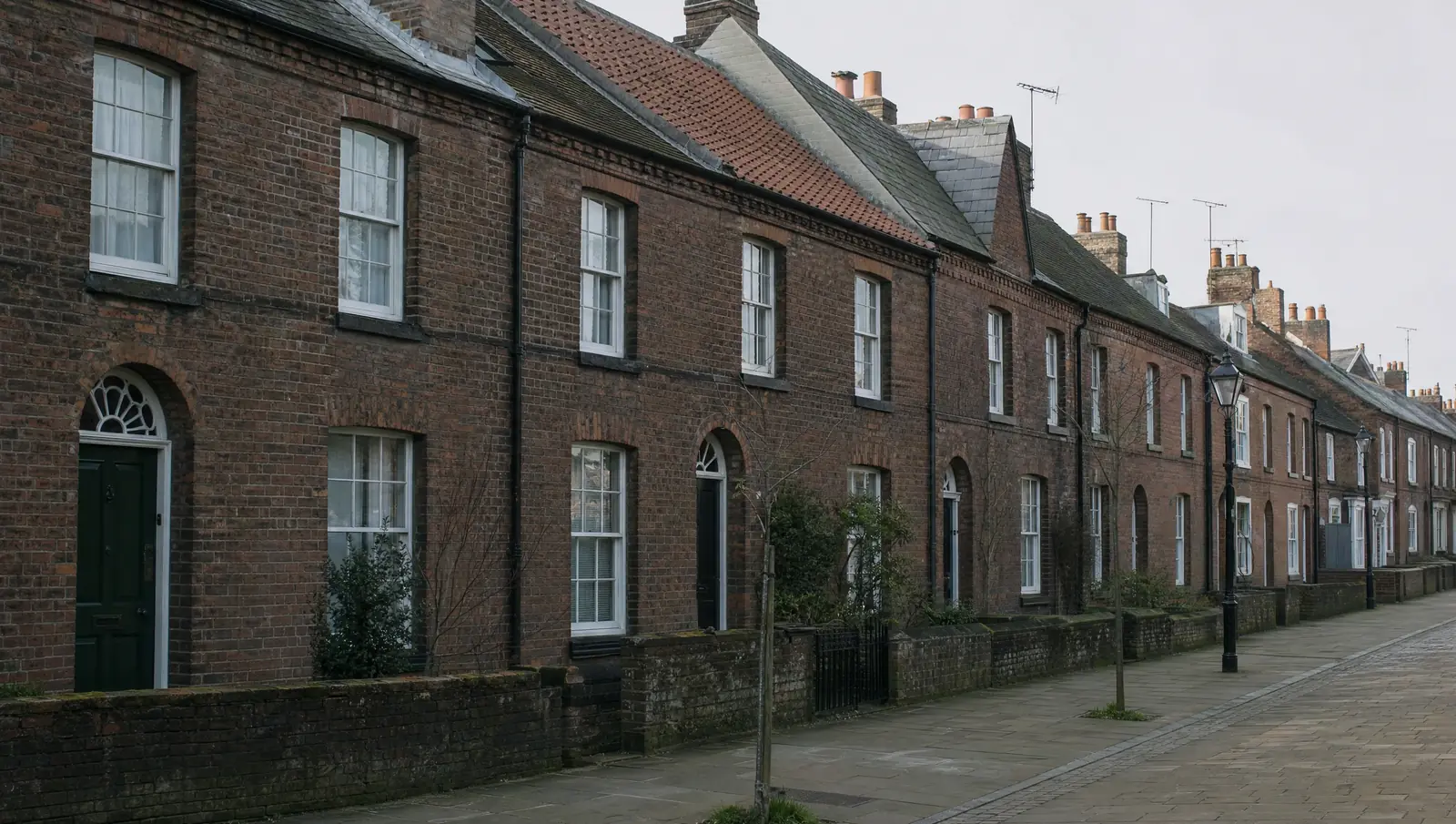
Most towns have a handful of listed buildings and a conservation area drawn tightly around a market square. Wisbech is not that town. There are over 250 listed buildings and monuments here, and they are concentrated along the river and around the Old Market, the Market Place and The Crescent. Those are not display streets. They are ordinary addresses where people live, let property and eventually need somebody to look at the roof.
The reason is the Georgian merchant town that grew up on the back of the port. Wisbech is noted for its Georgian architecture, and the finest of it stands on North Brink and South Brink facing each other across the tidal River Nene. One published description of the town makes the point that most English towns beside rivers turned their backs on the water, whereas at Wisbech the river is the centre of the picture, which the writer felt gave the place a foreign appearance.
Peckover House on North Brink is the best known example. It was built in 1722, it is owned by the National Trust, it has a walled garden behind it, and it began life as Bank House before being bought by the Quaker Peckover banking family in the 1790s. It is the headline building, but the point for a homeowner is the streets either side of it rather than the house itself.
The practical consequence is that an unusually high share of central Wisbech owners are affected by heritage controls, and a good many of them find out at the point where they ask a roofer for a price. If your property is on or near the Brinks, the Old Market, the Market Place or The Crescent, work on the assumption that this page applies to you until the council tells you otherwise. See the Brinks and town centre for how that plays out street by street, and areas we cover for everywhere else.
It cuts the other way too. Plenty of Wisbech property is not listed and not in a conservation area, and those owners should not be paying a heritage premium or waiting on consents they do not need. Knowing which category you are in is worth one phone call.
Conservation areas: what designation actually does
Fenland District Council is the planning authority for Wisbech. Not Cambridgeshire County Council, and not any neighbouring city council. Fenland has 10 conservation areas across the district.
A conservation area is designated for the special architectural or historic interest of the place as a whole rather than for any single building inside it. What designation gives the council is extra control. According to Fenland District Council, within a conservation area it has additional control over:
- Demolition of most buildings, whether they are listed or not
- Trees in the area
- Development generally
- Minor alterations, with cladding a building, inserting dormers and attaching satellite dishes given as the council's own examples
Read that last one twice. The council's own examples of the minor alterations it controls are cladding a building, inserting dormers and attaching satellite dishes. Two of those three happen on a roof, and neither of them is the sort of thing most owners would think to ask permission for.
The honest caveat other roofing sites will not give you
The council's conservation area information does not itself set out roof material rules. There is no published line saying that a conservation area address means clay rather than concrete, or natural slate rather than reconstituted. Anybody telling you otherwise has gone beyond what is actually written down.
So the only safe move is to ask Fenland District Council about your address before you order anything. Not after the pallets arrive on the pavement.
What is true is that strengthened control over development and over minor alterations, combined with the way permitted development rights can be withdrawn in these areas by direction, means the covering and the detailing of a roof can very easily become a planning matter. Whether it does on your particular building depends on where the boundary runs, on whether any direction covers your street, and on the building itself.
Two other things follow from designation that catch people out. Boundaries are drawn tightly and rarely follow what anybody would describe as the edge of an area, so two houses opposite each other can be treated differently. And control over trees means that the overhanging limb causing your valley to block is not automatically yours to cut back.
Listed buildings: a separate and much stricter regime
Listing is a different designation from conservation area status and it is far stricter. It attaches to the building itself rather than to the area, it covers the whole structure inside and out rather than only what can be seen from the street, and it applies whether or not the building sits in a conservation area.
Like for like, and what that really means
The governing principle on a listed building is that repairs should match what is there in material, in detail and in method. A clay pantile roof goes back as a clay pantile roof, laid the same way, finished the same way at ridge and verge, with a comparable mortar. Substituting a modern equivalent because it is cheaper or easier to get hold of is exactly the sort of change that needs consent, and often will not get it.
The principle reaches further than most people expect. The underlay, the ventilation strategy, the method of fixing the ridge, the mortar mix and even the colour of the pointing can all form part of the discussion, not just the visible covering. A dry verge unit that would be an obvious improvement on an exposed gable elsewhere may be unacceptable on a listed street frontage.
Consent
Listed building consent is required for works affecting the special interest of the building. Repair is not automatically exempt, because whether something counts as repair or as alteration depends on what is actually being done rather than on what it is called. Re-covering in a different material, changing the detailing, replacing historic fabric with modern fabric or altering the roof structure will normally require consent.
Listed building consent is separate from planning permission and separate again from building regulations approval. You can need all three for one job, and holding one of them does not imply anything about the others.
The part people do not realise
Carrying out works to a listed building that require listed building consent, without obtaining that consent, is a criminal offence. It is not an administrative oversight to be tidied up afterwards with a retrospective form.
The building owner is exposed, not only the contractor. A roofer who tells you it will be fine, or that nobody will notice from the street, is asking you to carry a risk that lands on you rather than on them.
Enforcement can also require the work to be undone and the building reinstated at your cost, which on a roof means paying for the job twice and paying for the scaffold twice as well.
How to check, and exactly what to ask
Establishing whether you are affected
- Check the national listing record for your address to see whether the building is listed and at what grade. Listing can cover a terrace as a group, an outbuilding, a boundary wall or a structure in the garden, so read the whole entry rather than the heading.
- Check the mapped conservation area boundary with Fenland District Council rather than assuming from the street name or from what your neighbours believe.
- Ask the council whether any direction removes permitted development rights at your property, and if so which rights it removes.
- If the building is listed, ask whether consents or conditions already exist on it. A previous owner's consent and the conditions attached to it can still bind you.
- If you are buying, get all of this established before exchange rather than afterwards. It materially changes the real cost of the roof you are about to inherit.
What to ask the council
Be specific. Vague questions produce vague answers and a vague answer is no protection at all. These are the useful ones:
- Is my property inside a conservation area boundary, and is it listed?
- Is there any direction affecting this property that removes permitted development rights, and what does it remove?
- I am proposing to re-cover the roof in the same material and the same detail. On this building, does that need consent?
- If part of the specification has to change, for example adding an underlay where there is none, changing the ventilation or fixing the ridge mechanically rather than in mortar, does that alter the answer?
- Is there a conservation officer who can comment on an acceptable specification before I go out to quote?
That last question is the one to push on. Getting the specification agreed in principle before firms price it means the quotes you receive are comparable and deliverable, rather than three different guesses at what will be allowed. It also removes the most common cause of a job stopping halfway through.
What to tell the roofer, and what to insist on
- That the property is listed, in a conservation area, or both, before anybody prices anything. It changes which firms should be quoting.
- What the council has already told you, in writing wherever you have it in writing.
- That you expect the quote to state the actual materials and the actual method rather than the word re-roof and a number.
- That no substitution happens on site without you being asked first, and that this is a condition of the job rather than a preference.
- That salvageable original tiles remain your property and are set aside, sorted and stacked on site. On a heritage roof that single line protects real value.
- That you want to see two references for comparable heritage work nearby, which you can go and look at from the road.
Heritage competence is a genuine specialism rather than a marketing phrase. Working with lime, matching reclaimed material, setting out irregular hand-made tiles and detailing a parapet or a secret gutter are skills that a firm doing modern estate re-roofs may simply not have. That is not a criticism of them, it is a reason to match the firm to the building. General tiling and slating and heritage tiling overlap less than the names suggest, and pantile roofs explains where the difference bites.
When you ask for quotes, say up front that the building is listed or in a conservation area. How it works explains how the matching is done and what we check before a firm receives an enquiry.
How it changes the quote and the timescale
The quote
- Materials. A required matching material can cost several times what a modern equivalent costs, and reclaimed stock is priced by scarcity rather than by list. This is the single biggest driver.
- Labour. Traditional detailing, lime mortar and hand-sorted irregular tiles are all slower to lay, and slower is the same thing as dearer.
- Wastage. Reclaimed material comes with a failure rate. A sensible quote allows for it rather than discovering it.
- Preliminaries. Somebody has to prepare an application and correspond with the council, and that time is real work.
- Contingency. Conditions attached to a consent can change the specification part way through a job.
Our published guide ranges are for straightforward domestic work and explicitly exclude heritage materials, listed buildings and conservation area requirements. Do not use them to judge a quote for a listed building, because they will make an honest quote look extortionate and a corner-cutting quote look sensible. The same warning applies to roof repair cost.
The timescale
Where consent is needed, think in months rather than weeks. An application has a statutory determination period and that period runs from validation rather than from the day you decided to do the work. Preparing the application comes before that. Then the firms that genuinely handle this work tend to be booked further ahead than general roofers, because there are fewer of them.
That matters most when the roof is already leaking, which is how a lot of people arrive at this page. The sequence is: deal with the water first using a temporary repair, then run the consent process properly for the permanent one. See emergency roofing if water is coming in now, roof leaks for finding the cause, and storm damage for the sequence after bad weather. A temporary cover does not need consent. Replacing a roof in the wrong material does.
Frequently asked questions
Check the national listing record for your address and confirm it with Fenland District Council. Listing attaches to the building rather than to an area, so two houses on the same street can be treated completely differently.
Read the whole entry rather than the heading, because a listing can take in a terrace as a group, an outbuilding, a wall or a structure in the garden.
Not automatically, and anybody telling you it does is going beyond what is published. Fenland District Council's conservation area information does not itself set out roof material rules.
What designation does do is give the council extra control over demolition, trees, development and minor alterations, with cladding a building, inserting dormers and attaching satellite dishes as its own examples. Combined with a listing or a direction removing permitted development rights, that can absolutely make the covering a planning matter. Ask the council about your address rather than assuming in either direction.
Fenland District Council. It is the authority for conservation areas, listed building consent and planning permission across the district, which has 10 conservation areas in total.
Cambridgeshire County Council is not the planning authority for this, and neither is any neighbouring city council, so make sure you are asking the right body before you rely on an answer.
Carrying out works that require listed building consent without obtaining it is a criminal offence, and the building owner is exposed rather than only the contractor.
Enforcement can also require the work to be undone and the building reinstated at your cost. On a roof that means paying for the job twice and for the scaffold twice.
It depends on what is actually being done. Genuine like for like repair is treated differently from alteration, but repair is not automatically exempt, and the line between the two is not always where an owner assumes it is.
Adding an underlay where there was none, changing how the ridge is fixed or swapping the material are all changes rather than repairs. Ask Fenland District Council before ordering anything. This page is general guidance, not planning advice.
Adding something to a roof is a different question from replacing what is already there, and the rules are tighter in a conservation area and tighter again on a listed building. Visibility from the street, position and the building itself all come into it.
Note that inserting dormers is one of the council's own examples of a minor alteration it controls in a conservation area. Ask about the specific thing you want to do, before you sign anything with an installer.
Usually yes, and materials are the main reason. A required matching material can cost several times a modern equivalent, reclaimed stock is priced by scarcity, and traditional detailing is slower to lay.
There is also application time and sometimes a contingency for conditions attached to a consent. Our published guide ranges deliberately exclude this kind of work, so do not use them to sense-check a heritage quote.
Not necessarily. Their property may sit outside the boundary, may not be listed, or the work may have been done without the consent it needed and simply not been picked up.
What a neighbour did is not evidence of what you are permitted to do. Check your own address with the council.
Get quotes from Wisbech roofers
Tell us your postcode and what needs doing. We pass it to vetted roofing firms covering that part of Wisbech, and they come back to you directly with quotes.
- Takes about a minute
- No cost to you, ever
- You choose who to speak to, and you can say no to all of them
Compare Wisbech roofers
Answer four questions. We pass your job to vetted roofers who cover your postcode, and they come back to you with quotes. No charge, no obligation.
We pass your details only to roofing firms that cover your postcode, so they can quote. We never sell your details on for other purposes. See our privacy notice.
Find out what your roof should cost
Compare quotes from vetted Wisbech roofers, or call us and we will point you at the right sort of firm for the job.