Roofing services
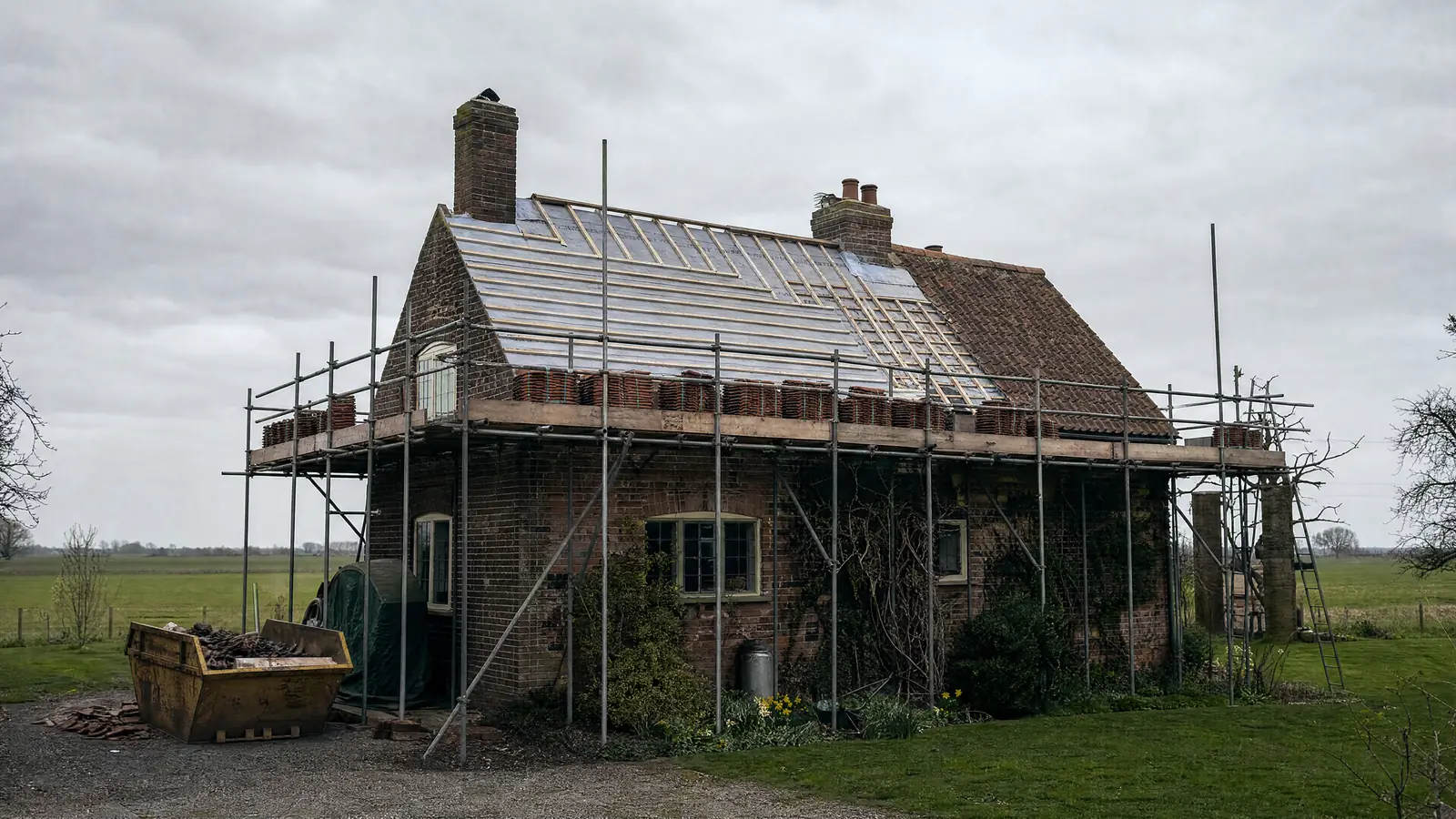
A new roof in Wisbech, from strip week to finish
A new roof in Wisbech is the biggest thing you will ever spend on a part of the house you cannot see, and on a site this exposed the fixing specification matters as much as the tile you pick.
When a re-cover is genuinely the answer
Re-roofing is the job most often sold to people who did not need it yet, and most often postponed by people who needed it two winters ago. Age is a poor guide in either direction. What decides it is how many parts of the roof have finished at the same time.
A roof is a system: covering, fixings, underlay, battens, mortar, flashings and structural timber. Replace one of those and you are repairing. Replace most of them and you are re-roofing. There is a third case that comes up more often here than inland: the covering and the timber are both sound, but the way the roof is held down was never adequate for the exposure and is now unravelling a few tiles at a time. That is still a re-roof, and it is worth naming because it does not fit the usual story about worn out tiles.
Replace the roof when
- Battens are soft or crumbling generally rather than in one patch. Nothing can be fixed back to rotten timber, which ends the repair conversation.
- The underlay has perished across the roof. On pre-1980s bitumen felt this is normal, and it cannot be renewed without stripping the covering.
- Tiles are being lost from several elevations after every serious blow, which means the fixing regime has gone rather than one detail.
- A slate roof is dropping slates from more than one elevation, which is nail sickness and it only accelerates.
- Concrete tiles are delaminating and shedding their surface across whole slopes rather than cracking individually.
Do not replace the roof when
- The recommendation arrived at your front door. Nothing about a roof can be judged from the pavement.
- Moss is the whole complaint. That is maintenance, not structure. See roof cleaning.
- One exposed elevation has gone and the other three are sound. Re-covering a single slope is a real and much cheaper option.
- The water is coming from a stack, a flashing or a gutter. All three spend their lives being blamed on the tiles.
- The roof has simply reached thirty and nothing is wrong with it. A birthday is not a diagnosis.
If you are central or listed, answer the consent question first
Wisbech has over 250 listed buildings and monuments, concentrated along the river and around the Old Market, the Market Place and The Crescent. In a town with a 2021 census population of 33,933 that is an unusually dense heritage core, and it means a meaningful share of the roofs in the middle of the town cannot simply be re-covered in whatever the owner prefers.
The planning authority is Fenland District Council. Fenland has ten conservation areas, and in a conservation area the council takes extra control over demolition, trees, development generally and minor alterations, giving cladding a building, inserting dormers and attaching satellite dishes as its own examples. Two of those three examples happen on a roof.
For a listed building, listed building consent is separate from planning permission and it bites on anything affecting the character of the building, which a roof covering plainly does. The consequence is not that you cannot re-roof. It is that the material and the detail have to be settled before anybody orders anything, which adds weeks rather than days.
- Establish whether the building is listed and whether it sits in a conservation area before you take quotes, not after
- Ask each firm directly whether it has done consented work in Fenland and who it dealt with
- Expect to be asked to match the existing covering rather than choose a new one
- Budget for the time. Running consent alongside quotes costs nothing; starting it afterwards costs you your slot in the diary
The detail is in our guide to listed buildings and conservation areas. If the building is neither listed nor in a conservation area, a like-for-like re-covering on an ordinary house normally falls under permitted development, though building regulations still apply to the work itself.
What the week actually looks like
A re-roof on an ordinary Wisbech semi is usually four to seven working days of roofing once the scaffold is up. On an exposed site the sequence is dictated by the forecast rather more than people expect.
Scaffold, and the sail it creates
Normally a day, and often several days ahead of the roofers. Debris netting and sheeting turn a scaffold into a sail, which is why a competent scaffolder ties in properly here and why sheeting sometimes comes off ahead of a forecast blow. If it stands on a neighbour's land or a footpath, ask who is arranging permission.
Stripping, one slope at a time
Covering, underlay and battens come off in sections so the house is never fully open, which is close to non-negotiable on a site with no shelter. Expect noise and dust in the loft, so clear anything you care about out of the roof space first.
The timber, seen for the first time in decades
With the covering off, the rafters are visible. This is where extra costs appear, and exactly why your quote needs a stated rate for replacing rafter ends. Ask to be shown anything you are being asked to pay for.
Underlay, battens and the fixing schedule
Breathable underlay, treated battens at the correct gauge for the covering, then tiles or slates laid from the eaves up and fixed to a schedule worked out for this roof rather than carried over from habit. Perimeter and corner zones take more uplift than the middle of a slope and should be fixed accordingly.
Edges, then the scaffold goes
Verges, ridges, hips, flashings and leadwork. A good firm sorts the guttering and any chimney flashing while access is still standing, because coming back later means paying for the scaffold twice.
Choosing a covering for an exposed site
The covering swings the price of the same roof by a factor of three or more, and on an unsheltered roof it also changes how much fixing work is needed to keep it up there. There is far more detail on the tiling and slating page, but in outline:
- Clay pantile. The regional idiom, and manufacturers market a Fenland pantile profile precisely because the look belongs to this part of the country. A single lap tile with a deep S profile, so fewer units per square metre than a plain tile and a distinctive roof line. Clay holds its colour where concrete fades. Each tile covers more area and therefore carries more wind load, so clipping is a specification item here rather than an optional extra.
- Concrete interlocking tile. The cheapest common option and quick to lay. Heavy, which genuinely helps in wind. Its weakness is the surface: once the coloured coating weathers off, the tile is porous and holds moss.
- Clay and concrete plain tile. Small format and double lapped, so roughly six times as many tiles per square metre and a labour bill to match. A much better looking roof.
- Natural slate. The longest lived mainstream covering. It wants a roofer who slates regularly, and on an exposed roof the head lap and the fixing keep it watertight rather than the quality of the slate on its own.
- Reconstituted and fibre cement slate. A sensible middle path where a slate look is wanted without natural slate money. Read what the guarantee actually covers. In a conservation area or on a listed building it is usually not acceptable.
Changing the covering is not always your decision
Swapping material or altering the roof shape takes the job outside permitted development. In the conservation areas and on the town's listed buildings the covering is agreed rather than chosen, so read the listed buildings and conservation areas guide and speak to Fenland District Council before you commit to a material.
There is a weight question too. Putting concrete interlocking tile onto a structure built for slate or pantile adds substantial load, and a competent firm raises that before the strip rather than during it.
New roof guide prices by house type
| House type | Guide range | What moves it |
|---|---|---|
| Full re-roof, terraced house | £5,500 to £9,500 | Covering, roof size, scaffold access, and the timber found on strip |
| Full re-roof, semi-detached | £7,000 to £13,000 | As above, plus dormers, valleys and how many exposed gables there are |
| Full re-roof, detached | £9,500 to £20,000 | Size and complexity, covering, and chimney work done at the same time |
| Single elevation re-cover, semi | £3,500 to £6,500 | Half the tiling, all of the set-up and most of the scaffold |
| Garage or outbuilding pitched roof | £1,800 to £4,000 | Area, and whether the roof structure itself needs work |
Guides only, not quotes, and no roofing firm is bound by them. Listed buildings, conservation area materials and hand-matched reclaimed pantiles sit well outside these figures. Full detail is in the new roof cost guide and the Wisbech cost table.
The lines that decide whether two quotes are comparable
Re-roof quotes vary so much in what they include that comparing totals tells you almost nothing. Compare these lines instead, and note that the sixth separates a quote written for this town from one written anywhere.
- Scaffold, including how long it stands and who pays if the job overruns
- Strip and disposal, with skip or grab costs stated rather than assumed
- The covering named by manufacturer, model and colour, not just clay pantile
- Underlay type and batten grade, both of which are quiet places for money to be saved
- A stated rate for replacement timber if rot is found on strip
- The fixing specification. How tiles, ridge, hip and verge are held down, and whether perimeter and corner zones are fixed more heavily than the middle. The current British Standard for slating and tiling expects this to be calculated from wind loading, exposure and roof geometry, not repeated from the last job.
- New flashings, or a clear note that sound existing lead is being reused and why that is acceptable
- The guarantee: how long, what it covers, whether it is insurance backed, and who honours it if the firm stops trading
Line those eight up against each other and most of the gap between two quotes explains itself. Where it does not, that is the question to put to the firm. The rest of what separates a good one from a plausible one is in how to choose a roofer, and the quote form takes about a minute.
Frequently asked questions
As a July 2026 guide including VAT: £5,500 to £9,500 for a terraced house, £7,000 to £13,000 for a semi-detached and £9,500 to £20,000 for a detached house.
Those figures assume a standard covering and ordinary access. Consent conditions, a heritage material or hand-matched reclaimed pantiles put the number somewhere else altogether. See the new roof cost guide.
On an ordinary house re-covered like for like, usually not, because that generally sits within permitted development. Building regulations still apply to the workmanship either way.
On a listed building, in a conservation area, or where you change the material or the roof shape, the answer can change completely. With over 250 listed buildings and monuments in the town, that applies to a lot of central properties. Check with Fenland District Council before you commit.
It is the schedule setting out how the tiles, ridge, hip and verge are held down, and it should be calculated from wind loading, site exposure and the geometry of the roof rather than assumed.
On flat, open land it comes out more onerous than it would on a sheltered site, often with every tile clipped in the perimeter and corner zones rather than every second or third one. Ask for it in writing, because it is a real cost difference and a real performance difference.
An ordinary semi is usually four to seven working days of roofing, plus scaffold up and down either side of that.
Weather stops tiling and stops mortar work, and on an exposed site a forecast blow stops work for safety as well. A firm that gives you a fixed February date and refuses to move it is either very lucky or about to do something badly.
Yes, and a single elevation re-cover is a common job here, particularly on a semi where one gable takes the weather and the other side is sheltered by the neighbour.
It will not be half the price, because the scaffold, the set-up and the disposal do not halve. Budget for roughly 60 to 65 per cent of the full figure.
No. The work happens from outside and the house stays habitable throughout, with the covering taken off and replaced a slope at a time so the building is never standing open.
Expect dust in the loft, noise from about 8am and no parking on your own drive for the duration. Clear the loft before they start.
Not on a pitched domestic roof. A genuine re-roof strips the covering, the underlay and the battens and renews all three.
Laying over the top conceals the timber so nobody can inspect it, loads a structure that was never designed for the extra weight, and leaves the perished underlay that is usually the real fault sitting exactly where it was. Any firm proposing it should be shown the door.
Get quotes from Wisbech roofers
Tell us your postcode and what needs doing. We pass it to vetted roofing firms covering that part of Wisbech, and they come back to you directly with quotes.
- Takes about a minute
- No cost to you, ever
- You choose who to speak to, and you can say no to all of them
Compare Wisbech roofers
Answer four questions. We pass your job to vetted roofers who cover your postcode, and they come back to you with quotes. No charge, no obligation.
We pass your details only to roofing firms that cover your postcode, so they can quote. We never sell your details on for other purposes. See our privacy notice.
Find out what your roof should cost
Compare quotes from vetted Wisbech roofers, or call us and we will point you at the right sort of firm for the job.