Guides
Roof leak repair in Wisbech: the way in is always up-slope of the stain
Roof leak repair in Wisbech starts with tracing rather than patching. Water runs along timber before it drips, so the wet patch is almost never under the hole, and once you know where it gets in the mending is usually a small job.
- Water travels
- The real culprits
- The fen damp problem
- Leak, damp or condensation
- Narrowing it down inside
- Before the roofer arrives
- Why the trace costs money
- The ceiling
A leak has three addresses and you can only see one
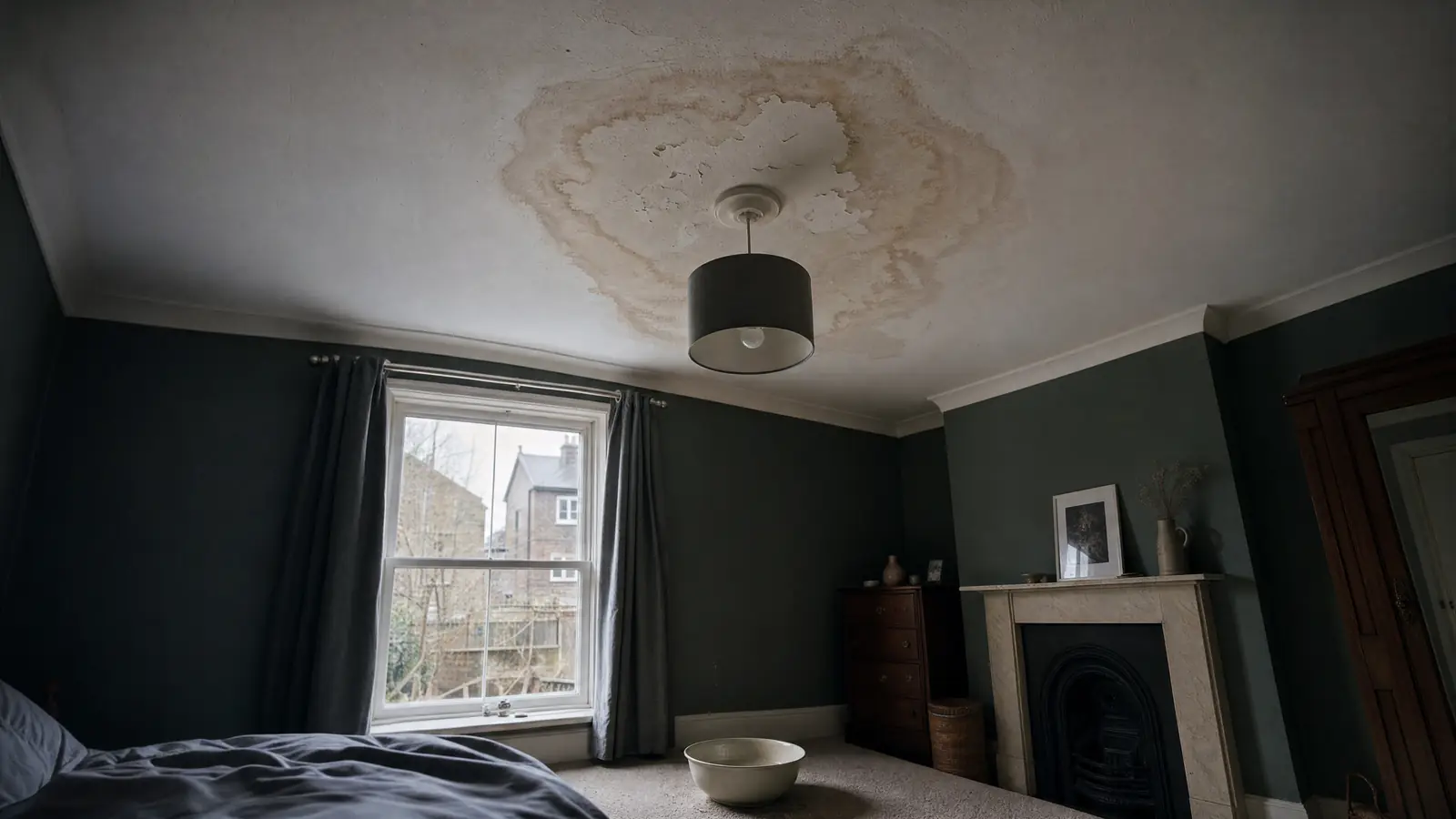
There is the point where water gets past the covering. There is the route it takes across the underlay and down a rafter. And there is the spot on your ceiling where it finally drips. On a pitched roof those points are commonly two to four metres apart, and the entry is always further up the slope than the stain, never below it.
That explains most of the money wasted on roof repairs. Somebody looks at the brown ring, puts back whatever tile sits roughly above it and takes payment. The drip returns on the next wind, because that tile was never letting water in. It is also why finding a leak is a job in its own right: the mending is often twenty minutes, and working out what to mend is what you are buying.
Two questions do most of the diagnostic work. First: is there anything up-slope of the stain that interrupts the roof? A chimney, a vent pipe, a dormer, a parapet, a point where a lower roof runs into a wall. If so, suspect that long before a tile. Second: does the ceiling get wet when it has not been raining? If it does, you may not have a leak at all, and in this town that deserves more weight than usual.
The real culprits, in the order to suspect them
Roughly the sequence a competent roofer works through on an ordinary Wisbech house.
1. Chimney flashing and flaunching
Chimneys generate a share of roof leaks wildly out of proportion to how much of the roof they occupy. One stack gives you the front apron, the step flashings up both sides, the back gutter, the flaunching the pots are bedded into, and the pointing. Any of them is a way in, and wet brickwork carries water sideways as happily as downwards. The classic sign is damp on a chimney breast upstairs. Cracked flaunching is the usual offender and is invisible from ground level. More in chimney repairs.
2. Valleys, and the hidden gutters behind Georgian parapets
A valley is the internal angle where two slopes meet, taking water off both through one narrow channel. Anything that slows the flow puts water where it was never meant to be: leaf litter, moss, a split lead or fibreglass lining, or mortar dropped in during ridge work.
Wisbech supplies a second version of the same problem. Many older town centre and Brink properties have a parapet at the front, and behind it a concealed box or lead gutter rather than an open eaves gutter. It cannot be seen from the pavement, it is almost never cleared, and when it blocks or splits the water goes into the wall head and the roof structure. If you own something Georgian around the Brinks and the town centre and damp appears high on an internal front wall, that gutter is the first place to look and the tiles are the last.
3. Abutment flashings
Every place a roof slope dies into a vertical wall: a rear extension, a lean-to, a porch, a dormer cheek, a garage. The correct detail is lead, cut into a raked out joint, wedged, pointed and dressed over the covering. What is often there instead is a triangular smear of sand and cement, which cracks within a few winters and then collects water rather than shedding it. If the damp is near a point where a lower roof meets a wall, start there.
4. Slipped, cracked or displaced pantiles
Common, obvious, and still not usually the first thing to check. On a pantile roof the failure is normally a broken nib, a corroded nail or a tile that has been stood on, and because pantiles are single lap and lean on their neighbours, one tile out of position opens a channel rather than a neat hole.
This is the cheap end of the work. Our guide range for putting back a few slipped tiles is roughly £150 to £350, and most of that is safe access rather than the tile. See roof repair cost and pantile roofs.
5. Underlay failure at the eaves
Beneath the covering sits felt or a breather membrane, there to catch whatever gets past the tiles and carry it into the gutter. The last strip, at the foot of the slope, dies first, and on plenty of roofs it was never dressed into the gutter properly to begin with. Once it has gone, water lands on the wall plate instead. What you see indoors is damp along the top of an upstairs external wall, which almost everybody reads as a wall problem. The remedy is an eaves felt tray, fitted by lifting the bottom courses, and it is not a re-roof.
6. Condensation wearing a leak's clothes
Under-diagnosed everywhere, and the reason people pay for roofing work that changes nothing. Warm wet air rises into the loft, meets a cold roof and turns back into water on the underside of the membrane: beaded felt, sodden insulation, black mould on the rafters and, in a cold snap, genuine drips through the ceiling.
The tells are that it is worst in cold dry weather rather than rain, spread over a wide area rather than tracking down one line, and wet underneath the membrane rather than on top. It very often began after somebody ducted an extractor into the loft, laid insulation across the eaves, or boarded the loft out.
The answer is ventilation: eaves vents, ridge or tile vents, extractor ducting taken through to outside air, and a hatch that seals. New tiles will do nothing, and a firm quoting tiles has not diagnosed it.
The fen problem: four kinds of wet, one blamed on the roof
Wisbech sits low, flat and close to water. The town is built on and around drained fen beside a tidal river, the ground holds moisture, and the climate is damp for long stretches of the year. That has an unhelpful consequence for homeowners: a great deal of the damp in Wisbech houses has nothing to do with the roof, and gets blamed on the roof anyway. Four things look similar on a wall and are not.
- Roof water. Arrives during or shortly after rain, tracks down a defined path, and is worst when wind drives rain at one elevation. The one a roofer fixes.
- Ground-related damp. Low on ground floor walls, often with a tide mark and salts, and it does not care whether it has rained. On older solid-walled property with no effective barrier at the base of the wall, on a site where the water table is close to the surface, this is common. It belongs to a damp specialist, not a roofer.
- Condensation. Worst in cold weather, on cold surfaces, in corners, behind furniture and under the covering. A ventilation and heating problem.
- Penetrating damp through the wall. Soft handmade brick with eroded lime pointing takes on water in driving rain and passes it inwards. The patch that produces upstairs looks very much like a roof leak, and repointing in cement rather than lime usually makes it worse.
None of that means your roof is fine. It means a firm that glances at the ceiling and quotes for tiles without going into the loft or asking when the damp appears has not diagnosed anything. Getting it wrong here costs you twice: once for the work that does not help, and again for the work that would have.
Leak, damp or condensation: a rough decision tree
Match the symptom to the likely cause before anybody quotes you for anything.
| What you can see | Most likely cause | Sensible next step |
|---|---|---|
| Stain appears or spreads only when it rains | Roof leak | Note the wind direction and how hard it rained, then get a proper trace |
| Only ever after driving rain from one direction | Flashing, verge, parapet or wall abutment | Check chimney, dormer, parapet and extension junctions before any tile |
| Wet in cold dry spells, better in mild wet ones | Condensation in the loft | Check loft ventilation and where the extractor fans actually discharge |
| Damp along the top of an upstairs outside wall | Eaves underlay, gutter or blocked parapet gutter | Watch the gutter line in heavy rain, then look at the underlay at the eaves |
| Damp low on a ground floor wall, tide mark, salts | Ground-related damp | Not a roofing job. An independent damp survey is the right spend |
| Patch on an upstairs wall, weather elevation only | Penetrating damp through the brickwork | Look at the pointing and any render before you look at the roof |
A guide, not a diagnosis. Water is genuinely awkward to trace and even good firms occasionally need a second visit.
Narrowing it down yourself, from inside the house
You do not need to go on the roof and you should not. Nearly all of the useful evidence is available from a loft hatch, a torch and an upstairs window.
- Get into the loft with a torch while it is raining. The single most useful thing a homeowner can do, and the step almost everybody skips.
- Find wet timber, then follow it uphill until it dries. Water runs along a rafter and drips off the low point, so the entry is above the wet.
- Read the history. Old tide marks mean years of this. One clean wet streak means it is recent, which matters for an insurance claim.
- Check which side of the membrane is wet. Wet on top in one place means water through the covering. Wet underneath across a broad area means condensation.
- Note what the wet point lines up with: the chimney breast, the party wall, the bathroom below, a parapet, or a lower roof outside.
- Photograph it all, dated. Timber dries within days, and the photographs are what the roofer and any insurer will work from.
- Do not just put a bucket under it and carry on. That buys time to get it looked at, and nothing else.
Stay off the roof
Falls from ladders are the commonest serious accident in home maintenance, and a wet pantile roof is about as unforgiving a surface as domestic property offers. Pantiles crack easily underfoot because the load lands on an unsupported curve, so an amateur inspection can create the next leak.
Nothing is visible up there that a roofer with proper access cannot see more safely. If water is coming in now, see emergency roofing.
What to do before the roofer arrives
- Move anything that matters out from under the drip.
- Turn off the power to that part of the house if water is near a light fitting, a downlighter or a socket. Water in a ceiling rose is a real electrical risk, not a theoretical one.
- Contain the water but let it drain. A ceiling holding water is more dangerous than a ceiling dripping water.
- Photograph everything, dated, inside and from the ground outside, before anything gets covered or tidied.
- Clear the gutters and check the downpipes if it can be done safely. Blocked drainage sits behind a surprising proportion of the leaks people assume are roof defects, and ruling it out is free.
- Write down the timeline. Which nights, which wind direction, how long after the rain starts, and whether it happens in mild wet weather or only in cold snaps. That list can halve a trace.
- Do not authorise work until somebody has identified a cause. A quote for an undiagnosed leak is a guess with a number on it.
Why finding it can legitimately cost more than fixing it
Some people assume they are being taken advantage of here. Usually they are not. A roofer arriving at a ceiling stain with no obvious external cause has been asked to investigate, not to repair. That means safe access, which above single storey means a tower or a scaffold, then a systematic check of every flashing, abutment, valley, parapet and penetration, tiles lifted in several places, and sometimes a water test with one person on the roof and one in the loft.
That is hours of skilled time, and the repair at the end might be a strip of lead and half an hour. A bill where the diagnosis costs more than the cure is not a rip-off. It is what an honest job looks like on a difficult leak.
What is not acceptable is paying for a trace that never happened. If nobody has been in the loft and nobody has been on the roof, ask what the diagnosis is based on, and ask in writing what happens if the leak returns. See how to choose a roofer. For reference, lead flashing to a chimney is a guide range of £350 to £850 and ridge work £450 to £1,200. See roofing costs.
The ceiling: cosmetic, or a reason to shut the door
A brown ring on plasterboard is cosmetic. Once everything has dried out it wants a stain block and paint, and it can wait until the roof is dealt with. Painting it beforehand only wastes the paint.
A bulge is not cosmetic. Sagging board is holding water and can let go in one piece with no warning, bringing the water with it. That is a genuine injury risk, particularly to children and pets.
Never stand under a sagging ceiling
Keep everyone out of the room and shut the door. Do not push furniture underneath to catch it, and do not prod at it from directly below.
The controlled option is to pierce the lowest point of the bulge from the side, at arm's length, with something on a long handle and a bucket underneath, so that it drains rather than collapses. If you are not confident doing that, keep the door shut and tell the roofer it is urgent.
Lath and plaster ceilings behave differently, and there are a lot of them around the Brinks and the town centre. They absorb a great deal of water before showing any, then release in large heavy sections. Treat one as more serious than the plasterboard equivalent, not less.
Structurally, watch the timber rather than the plaster. A leak that has run for one winter is a nuisance. One that has run for several years soaks the rafter feet and the wall plate, and wet rot in a wall plate is a scaffolded repair that dwarfs the cost of the flashing that caused it. That is the argument for dealing with a small leak now.
Leaks in several unrelated places on the same roof mean the fixings, the underlay or the covering have reached the end of their life. Roof repairs sets out where that line falls and pantile roofs covers whether a pantile covering is finished or simply needs refixing.
When you want somebody to look at it, ask for quotes and describe the symptom rather than your diagnosis. Say what sort of property it is: a parapeted Georgian house on the Brinks and a postwar semi out towards Walsoken leak in different places. How it works explains what happens next.
Frequently asked questions
Take a torch into the loft while it is raining. Find the wet timber, then follow it up the slope until it dries out, because water runs downhill along a rafter before it drips. Whatever is causing it sits above the wet, not under the stain on your ceiling.
Then think about what lies up-slope of that point on the outside: a chimney, a valley, a parapet gutter, a dormer, an extension junction. That is normally where the answer is.
Timing and spread separate them. A leak follows the rain, appears in a defined position and shows as wetness on top of the underlay along one track. Condensation follows the cold, is spread across a wide area and shows as wetness on the underside of the underlay.
Condensation is a ventilation problem. Replacing tiles will not improve it by any amount, so a quote for roofing work to cure a condensation problem is a quote worth refusing.
The town sits low and flat on drained fen beside a tidal river, so ground moisture is a normal condition rather than an unusual one, and a lot of the older housing has solid walls with no effective barrier at the base.
The practical effect is that ground-related damp and penetrating damp through soft brickwork get misattributed to the roof more often here than they would inland. Before you spend money on tiles, make sure somebody has established that the water is coming from above.
It depends entirely on the cause. As guide ranges, putting back a few slipped tiles is roughly £150 to £350, replacing lead flashing to a chimney £350 to £850, and repointing or replacing ridge tiles £450 to £1,200.
Add the cost of finding it where the cause is not obvious. Those are researched guide ranges rather than quotes, and no roofing firm is bound by them.
Often, yes. Cracked flaunching, a split valley lining, a mortar fillet where lead belongs, a blocked parapet gutter or a slipped tile are all visible in dry weather, and old staining in the loft shows the path the water has been taking.
Where nothing obvious presents itself, a controlled water test can reproduce it, working up the slope in sections with somebody watching in the loft. That takes time, which is why a leak trace is charged as a job rather than thrown in.
A leak caused by a sudden event such as storm damage is normally covered. A leak caused by a worn out covering, perished mortar or lack of maintenance normally is not, because buildings policies insure events rather than deterioration.
The resulting damage inside, to ceilings and decoration, is often covered even where the roof repair itself is not, so it is worth asking. Read the policy wording rather than the summary.
Less time than it feels like. While it is only wetting underlay and one rafter it is cheap. Once it has soaked the rafter feet and the wall plate across a couple of winters you are into rot repairs, scaffolding and a bill many times the size of the original one.
The cost curve on roofing is unusually steep. Very little about a roof gets cheaper by being ignored.
Go back to the same firm first and ask them to return. On a genuinely difficult leak a second visit is not unusual, and a decent firm treats it as part of the job rather than as a new one.
If they will not come back, or want to charge again for a repair that did not work, you have learned something about them. Ask before you commit what happens if the leak returns, and get the answer in writing.
Get quotes from Wisbech roofers
Tell us your postcode and what needs doing. We pass it to vetted roofing firms covering that part of Wisbech, and they come back to you directly with quotes.
- Takes about a minute
- No cost to you, ever
- You choose who to speak to, and you can say no to all of them
Compare Wisbech roofers
Answer four questions. We pass your job to vetted roofers who cover your postcode, and they come back to you with quotes. No charge, no obligation.
We pass your details only to roofing firms that cover your postcode, so they can quote. We never sell your details on for other purposes. See our privacy notice.
Find out what your roof should cost
Compare quotes from vetted Wisbech roofers, or call us and we will point you at the right sort of firm for the job.