Roofing services
Chimney repairs in Wisbech
A chimney occupies a tiny fraction of the roof and produces a wholly disproportionate share of its leaks, which is why chimney repairs in Wisbech come up so often out here, with nothing standing between the stack and the weather.
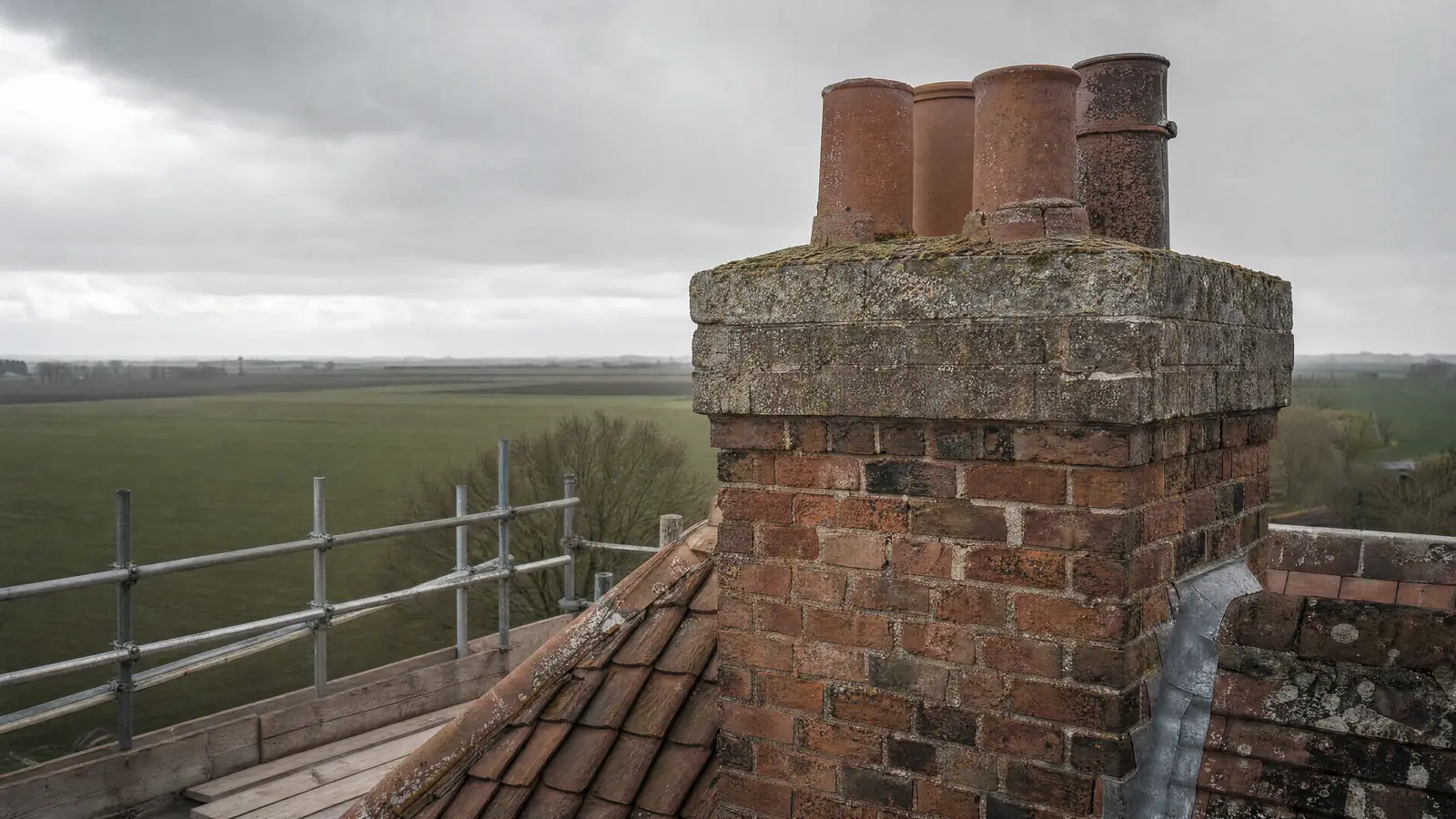
Nothing stands between a fen stack and the weather
A chimney is the most abused part of a house. It stands proud of the roof on all four sides with no shelter at all, it is built of brick and mortar that has been sitting outdoors for a century or more on a great many buildings in this town, and for most of that time it was heated and cooled from the inside.
Exposure is the local aggravating factor. In a dense terrace on a sheltered street a stack gets some protection from the roofs around it. On flat, open ground it gets none. Driving rain saturates the weather face rather than running off it, saturated brick and frost between them blow the face off, and the same wind that soaks it finds every open joint. Stacks here weather unevenly, with one face visibly worse than the others, and that is the face worth photographing before anybody quotes.
A stack also creates the most complicated waterproofing detail on a domestic roof. The junction needs a front apron, stepped flashings up both sides, soakers under the tiles or slates, and either a back gutter or a saddle behind it. That is five separate pieces of leadwork, each of which has to be right, on a structure that moves slightly relative to the roof it passes through.
So if there is a damp patch anywhere near a stack, or a stain on a chimney breast in an upstairs room, start here rather than assuming the covering. Our roof leaks guide explains why stack leaks so reliably show up in the wrong place.
The five failure points, roughly in the order they go
- The flaunching. The sloped mortar cap on top that beds the pots in. It is thin, it faces straight up at the sky and it takes all the weather, so it cracks first.
- The pointing. Joints erode, and on a stack soaked repeatedly from one direction they erode unevenly. Open joints let the brickwork saturate, and the damp then works its way down inside.
- The flashings. Lead pulls out of its chase, mortar fillets crack off, or somebody swapped proper leadwork for cement or tape decades ago and nobody has looked since.
- The bricks. Soak a brick and freeze it and the face blows off, which is spalling. Once it has taken several courses, repointing is no longer the answer to anything.
- The lean. Decades of flue gases cause sulphate attack, which expands the mortar on the warmer side and pulls the stack out of plumb. That is a rebuild, and it is a safety matter rather than a maintenance one.
The repairs, and what each one actually cures
Re-flaunching
The old mortar cap is cut off, the pots are re-set and a new flaunching is formed with a decent fall so water runs off rather than sitting on it. A small job with a large effect, because a cracked flaunching lets water into the top of the stack where it has the whole height of the chimney to work down through. Very often this and new flashings together cure a leak that has been blamed on the roof for years.
Repointing, and the mortar question
Repointing means raking the old joints out to a proper depth and refilling them. The depth matters, because a superficial smear of new mortar over old joints looks fine for a season and then comes off in sheets.
The mix matters more, and it matters more in Wisbech than in most places, because so much of the older stock here is soft brick built with lime mortar. A hard cement mortar on soft brick is worse than no repointing at all: the mortar ends up stronger than the brick, so moisture that used to escape through the joint escapes through the brick face instead and the face spalls off. On a listed building it may also put you the wrong side of consent as well as the wrong side of good practice. A firm that does not raise the mortar mix unprompted on a period stack is not the firm you want on it.
Flashings
New lead, dressed to the roof line, wedged into a chased mortar joint and pointed up. Code 4 is the usual domestic specification, and leadwork done to that standard will still be there when the covering around it is not.
What you want to avoid is the cheap version: a fillet of cement run down the junction, or self adhesive flashing tape. Both crack or peel within a few years on an exposed elevation, and both have to be stripped off before the proper repair can happen, so the cheap fix costs you twice.
Rebuilding above the roof line
Where the brickwork has spalled badly or the stack has begun to lean, the section above the roof comes down and is rebuilt, reusing sound bricks where possible and matching them where not. New flashings go in as part of the same job, because the leadwork has to come out to do it anyway.
Capping a disused stack
Where the fireplace has gone and the flue is redundant, the stack has two remaining jobs: keep rain out and keep breathing. A vented cap or a capping pot does both, shedding water while still letting air move up the flue.
Close a flue off completely at both ends and the moisture already in the brickwork has nowhere left to go, so it comes out as staining on the chimney breast in the room below. A great many unexplained damp patches on upstairs walls are nothing more complicated than this.
Chimney repair guide prices in Wisbech
| Job | Guide range | What moves it |
|---|---|---|
| Replace lead flashing to a chimney | £350 to £850 | Stack size, scaffold, and the state of the brickwork behind it |
| Re-flaunch and re-set pots | £300 to £700 | Number of pots, stack height, and scaffold or tower access |
| Chimney repointing | £600 to £1,600 | Height, scaffold, extent of the work and the mortar specification |
| Rebuild the stack above roof level | £1,400 to £3,500 | Number of courses, brick matching, and new flashings included |
| Cap a disused stack, vented | £250 to £600 | Access, and whether the flaunching is renewed at the same time |
| Chimney removal to below the roof line | £900 to £2,200 | Scaffold, making the roof good, structural checks and support |
| Full chimney removal to ground | £2,000 to £5,000 | Internal making good, structural support, plastering and disposal |
Guides only, not quotes. Lime mortar work on a period or listed stack sits above these figures. Scaffolding is frequently the largest single line, which is why chimney work done alongside a re-roof or guttering replacement is so much cheaper than doing it on its own. See the roof repair cost guide and the full Wisbech cost table.
Taking a stack down is structural, and often a consent question too
Removing a chimney is a popular job. It takes away a maintenance liability, frees up floor space and removes a weak point from the roof. It is also the chimney job that goes wrong most often, largely because the difficult part of it is not roofing.
The critical point is that a chimney breast and stack are usually load bearing masonry, and they frequently provide lateral restraint to a gable or a party wall. Cutting a section out of the middle and leaving what is above it unsupported is dangerous, and it happens.
- Removal is building regulations work. Taking out a chimney breast or stack needs building control approval, and the structural support has to be designed rather than improvised.
- Anything left above must be carried. Remove the breast downstairs and leave the stack in the loft, and the remaining masonry has to sit on gallows brackets or a beam sized for the load.
- A shared stack is a shared decision. Stacks on terraces and semis frequently straddle the party wall, which puts the job squarely in party wall territory and makes it your neighbour's business too.
- The roof has to be properly closed. Removing to below the roof line means new rafters, battens, underlay and covering across the hole, matched to what is already there, not a sheet of something laid over the gap.
- Account for the flue you are losing. Anything still using it, a boiler, a stove or a ventilation path, has to be resolved before the stack comes down.
Then the appearance question, which in this town is not a matter of taste. Fenland District Council has ten conservation areas, and in a conservation area it takes extra control over the demolition of most buildings, whether they are listed or not, as well as over minor alterations. Removing a stack from a listed building, or from a building in a conservation area, is not something to assume you are allowed to do. Establish it before you budget for it, and read the listed buildings and conservation areas guide first.
There is a straightforward visual argument as well. On a terrace, a run of matching stacks is part of what the street looks like, and taking one out of the middle is noticeable from the pavement for as long as the building stands.
Related pages
Roof leaks
Why the wet patch is rarely under the hole, and how to work out whether the stack or the covering is responsible.
Read moreRoof repairs
Everything else that fails on a pitched roof here, with guide prices and the point at which repairing stops paying.
Read moreStorm damage
What to do in the first hour, how claims actually work, and the trader who knocks the following morning.
Read moreFrequently asked questions
£600 to £1,600 for a domestic stack, as a July 2026 guide including VAT. Most of that spread is access: reachable off a tower is one number, needing a full scaffold is another.
Where a re-roof or a guttering job is already booked, have the chimney priced alongside it. You are paying for the expensive part, the access, either way.
Because there are five separate ways into a stack and only one into the roof beside it: split flaunching, open joints, failed lead, spalled brick and a back gutter that was never formed properly.
Damp on a bedroom chimney breast, or a stain that appears and fades with the wind direction, is the signature of a stack rather than of the covering.
On soft older brickwork, usually yes. A hard cement mortar is stronger than the brick around it, so moisture is forced out through the brick face instead of the joint and the face spalls away.
On a listed building the mortar specification can form part of what is consented, so it is not just a technical preference. A firm that does not raise it on a period stack has not understood the building.
If the flue is genuinely redundant and the stack is in poor condition, removal to below the roof line is often the cheaper long term answer at £900 to £2,200 as a guide, against repointing and rebuilding that can approach the same figure.
It is building regulations work, it can be a party wall matter, and in a conservation area or on a listed building it may not be allowed at all. The cheap middle course is a vented cap on a sound stack, at £250 to £600.
Cap the top so rain stays out, yes. Seal the whole thing, no.
Without air moving through it, the moisture held in the brickwork has nowhere to go and reappears as staining on the breast downstairs. Vented cap above, an air brick or vent below.
The sloping mortar cap across the top of the stack that holds the pots and throws water clear. Being thin, exposed and horizontal, it is normally the first part of a chimney to fail.
It is one of the best value small jobs on any roof at a guide £300 to £700, because once that cap is cracked the water is inside the top of the stack with the entire height of the chimney to travel down through.
Get quotes from Wisbech roofers
Tell us your postcode and what needs doing. We pass it to vetted roofing firms covering that part of Wisbech, and they come back to you directly with quotes.
- Takes about a minute
- No cost to you, ever
- You choose who to speak to, and you can say no to all of them
Compare Wisbech roofers
Answer four questions. We pass your job to vetted roofers who cover your postcode, and they come back to you with quotes. No charge, no obligation.
We pass your details only to roofing firms that cover your postcode, so they can quote. We never sell your details on for other purposes. See our privacy notice.
Find out what your roof should cost
Compare quotes from vetted Wisbech roofers, or call us and we will point you at the right sort of firm for the job.