Roofing services
Roof repairs in Wisbech
Roof repairs in Wisbech are edge work. On a flat, open site a roof rarely fails in the middle, it fails at the edges, and the repair worth paying for is the one that establishes why.
Find out what failed before you ask what it costs
Repair enquiries here nearly always start with one of three things. A pantile or a slate in the garden after a windy night. A stain on a bedroom ceiling that appears when the weather comes from one particular quarter and dries out when it swings round. Or a ridge that has visibly lifted at one end and is now sitting proud of its own line.
The second of those is the local signature and it is worth understanding, because it points at a completely different repair from a hole. Rain on an unsheltered site does not arrive vertically. It arrives at an angle, hard, and it gets driven up under laps, in behind flashings and around verge tiles that would never leak in still conditions. A leak that only shows in a blow is almost never a missing tile. It is a detail that has lost its seal or its fixing, and pointing a roofer at the ceiling stain will not find it.
Water then travels before it drops. It runs along the top of a batten, down the side of a rafter and across a ceiling joist, so the wet patch inside is routinely a metre or more from the defect and sometimes on the other side of the room. Anybody pricing a repair over the phone from your description of the stain is guessing. Our roof leaks guide goes through the tracing process properly.
- Somebody has actually been up, from a ladder, a tower, a scaffold or a drone, and can tell you what they found
- You are asked which wind direction brings the leak on, because that is a diagnostic question rather than small talk
- The quote names the defect instead of saying repair to roof
- You are told whether this is one failure or the first of a run of them
- Photographs are offered without you having to ask for them
That last point carries more weight than it sounds like it should. Photographs of the defect are what make a second opinion possible. A roofer who will not show you anything is asking you to buy something you cannot see, which may not feel worth arguing about on a two hundred pound job, right up until the same firm quotes you for a whole new roof.
What the wind takes off a Wisbech roof
Almost every domestic repair in the town comes back to one of five details, and four of them sit at the edge of the roof rather than in the middle of it.
1. The ridge
The ridge is the highest line on the building, the first thing the wind meets, and on older roofs it is held down by nothing more than sand and cement. Mortar is a bedding, not a fixing. Decades of frost and thermal movement crack it, and once a ridge tile is loose at one end the wind has a handle on it. On a sheltered site that might sit there for years. Here it is usually the beginning of a sequence.
2. The verge
A gable end is the most vulnerable part of a tiled roof, because the covering has a free edge and air flowing over the gable creates lift underneath it. Verge pointing cracks out, the end tiles lose their bedding, and the next strong wind gets under the course and takes a run of tiles rather than one. Re-bedding a verge is a modest job. Making good an elevation after the verge has let go is not.
3. Slipped and lifted pantiles
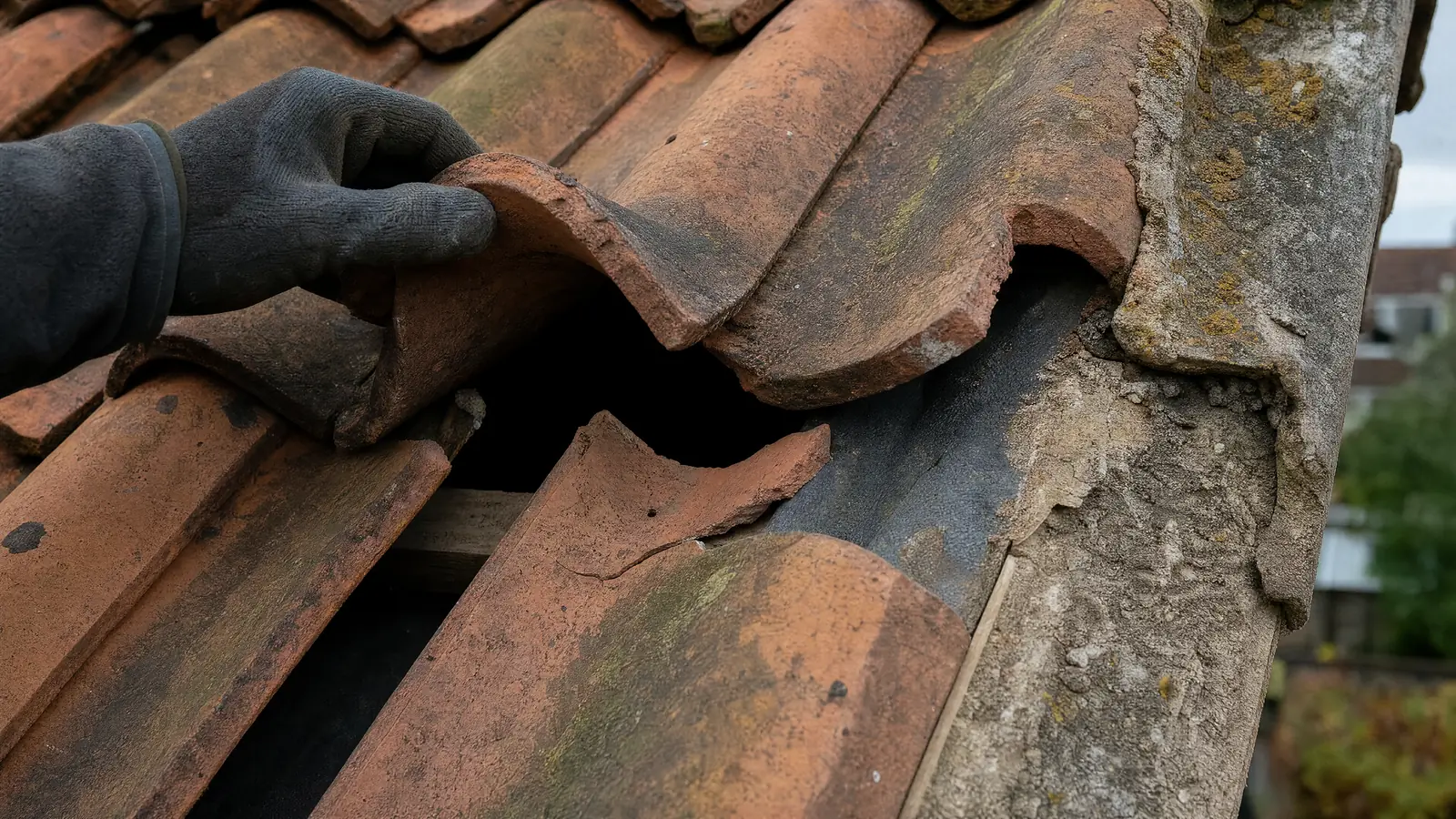
Clay pantiles are characteristic of this part of the country and they are a single lap covering, hung on nibs and interlocked sideways. A pantile that has lost its clip or its nail is held by weight and interlock alone, so it can be lifted, rattled out of its channel and dropped. Concrete interlocking tiles behave the same way once their fixings corrode. On a slate roof the equivalent is nail sickness, where the nails rust through and slates start letting go across whole elevations rather than in one spot.
4. Flashings and abutments
Every junction is a joint and joints leak: chimney stacks, the wall where a single storey extension runs into the house, dormer cheeks, soil vent pipes and valley gutters between two slopes. Done properly these are lead, dressed and wedged into a chased mortar joint. Done cheaply they are a smear of cement or a strip of self adhesive tape, which on an exposed elevation buys two or three winters. If the damp is anywhere near a stack, start at chimney repairs, because stacks cause leaks out of all proportion to the area they occupy.
5. The eaves
The bottom edge is where the underlay is most likely to have perished and where wind first gets underneath the covering. On anything built before roughly the mid 1980s the underlay is bitumen felt, which goes brittle, tears and sags into the gutter where it sits holding water. None of that is visible from the ground, which is the single biggest reason quotes change once somebody is up there looking.
Roof repair guide prices in Wisbech
| Repair | Guide range | What moves it |
|---|---|---|
| Replace a few slipped or cracked tiles | £150 to £350 | Whether a ladder or tower reaches it safely, or a scaffold is needed |
| Re-bed or repoint a run of ridge tiles | £450 to £1,200 | Length of the ridge, and mortar bedding against a dry ridge system |
| Re-bed verge mortar to one gable | £300 to £900 | Height, access, and how many tiles below it have already moved |
| Replace lead flashing to a chimney | £350 to £850 | Stack size, scaffold, and the state of the brickwork behind it |
| Repair or reline a valley | £450 to £1,400 | Length, lead or GRP, and how much covering comes off to reach it |
| Refix an eaves course and renew the underlay | £400 to £1,100 | Run length, and whether the fascia has to come off to do it |
| Patch repair to a felt flat roof | £250 to £700 | Whether the deck under the failure is still sound |
Guides for straightforward domestic work, not quotes, and no roofing firm is bound by them. Listed buildings, conservation area requirements and hand-matched reclaimed pantiles sit outside these figures. There is more detail in the roof repair cost guide and the full Wisbech cost table.
One breached edge is how a whole elevation goes
The argument for dealing with small roof defects quickly is a bit different here from the one you will read on a national site. It is not mainly about water, although water matters. It is about what a breach does to everything around it.
A tiled roof resists wind as a system. Each tile is held by its fixing, weighted by the courses above and sheltered by the tiles beside it. Take one out at a verge or a ridge and the wind now has an edge to get under and a route into the space beneath the covering, and the tile next along is doing a job it was never designed to do on its own. That is why a single missing pantile at a gable in October is a genuinely different problem from a single missing pantile halfway up a slope, and why a good firm treats it as more urgent than it looks.
The water argument still applies underneath all that. A hole dealt with this autumn is a tile. The same hole left through three winters is a tile, a run of batten, a stretch of underlay, a ceiling and possibly a rafter end, because the felt beneath has been taking direct rain the whole time. What the tile costs never changes. What surrounds it multiplies.
When repairing stops being sensible
- This is the third separate repair in two years on the same covering
- Tiles are coming off more than one elevation rather than from one exposed corner
- The battens are soft wherever a tile is lifted, not just at the failure
- Concrete tiles are delaminating and shedding their surface across whole slopes
- The repair needs a full scaffold on a covering that is close to the end of its life anyway
That last line is the practical test. Scaffolding is frequently the largest single item on a roofing quote and it costs the same whether it stands for a day or a fortnight. If you are paying for access on a roof you expect to re-cover within a few years, get both numbers and make the decision with them side by side. The new roof cost guide gives you the second figure and new roofs and re-roofing sets out the honest trigger points.
What has to be on a repair quote
Repair quotes are short, which makes the missing parts easy to overlook. Five things, and the fourth is the one people in this town should insist on.
- The defect, named. Not repair to roof but re-bed 4m of ridge and replace nine slipped pantiles to the rear elevation.
- Access. Ladder, tower or scaffold, and whether the scaffold sits inside the figure or gets added afterwards.
- Materials. Whether the replacements are reclaimed, matched or nearest current equivalent, and what lead code is going in.
- The fixing. How the replacement tiles, ridge or verge are being held down. On an exposed roof, re-bedding in mortar with no mechanical fixing behind it is putting the same failure back.
- What happens if it is worse underneath. A rate for extra battens or underlay, agreed before work starts rather than produced on the day.
Two things worth pausing on
A quote dramatically cheaper than the others is rarely a bargain. It usually means access is being done off a ladder where it should not be, or that the visible symptom is being covered while the cause is left alone.
Anybody who knocked at your door after a windy night, having spotted a problem from the pavement, should be shown politely off the property. There is more on that in the storm damage guide and in how to choose a roofer.
The repair is different depending on where you are
Wisbech is a small town with two quite separate roofing conversations going on inside it, and which one you are having depends on the building.
The Brinks and town centre
Georgian frontages and a dense concentration of listed buildings, where the material and often the method have to be agreed before anyone starts.
Read moreWaterlees and Clarkson
Two of the town's ten wards, outside the listed core, where the conversation is usually about fixings and exposure rather than consent.
Read moreWalsoken
A ward on the edge of the town with open ground on the approaches, so ridge, verge and eaves detailing does most of the work.
Read moreElm and Emneth
Fen villages outside the town, where gable ends take the weather with nothing in front of them and verge repairs come round often.
Read moreLeverington and Wisbech St Mary
Village properties of very mixed age, so the same symptom can mean a small repair on one roof and a re-cover on the one next door.
Read moreEverywhere else
The whole of Wisbech and the surrounding Fenland PE13 and PE14 postcodes, including the villages out towards Upwell and Walsoken.
Read moreFrequently asked questions
Replacing a few slipped or cracked tiles is typically £150 to £350 including VAT as at July 2026, assuming a ladder or tower reaches the work safely.
The figure climbs quickly once a scaffold is needed, which is why the same repair costs several times more on an awkward rear elevation. The roof repair cost guide breaks it down further.
Because on an open site rain arrives at an angle rather than falling straight down, and it gets driven up under laps, behind flashings and around verge tiles that are perfectly watertight in still weather.
It points at a failed detail rather than a hole. Tell whoever quotes which direction the wind is in when it happens, because that narrows the search considerably.
Emergency work and temporary covering, yes. Anything relying on mortar, lead bossing or adhesive, no, because none of it cures or bonds properly wet and the repair comes back early.
A firm that insists on waiting for a dry, calm day to do the permanent fix is not stalling you. Working at height on a wet roof in wind is also how people get hurt.
Usually a genuine like-for-like repair in matching materials is straightforward, but the moment the work goes beyond that, or changes what the roof looks like, consent can be required.
Wisbech has over 250 listed buildings and monuments, concentrated along the river and around the Old Market, Market Place and The Crescent, so this catches a lot of people out. The planning authority is Fenland District Council. See our guide to listed buildings and conservation areas before you commit.
A properly executed repair to an otherwise sound roof should last as long as the rest of the covering. New lead flashing has decades in it, and re-bedded ridge mortar with proper mechanical fixing behind it should give fifteen years or more.
A repair that fails within a couple of years almost always means the cause was never found and only the symptom was covered up.
For ordinary wear and tear, no. Buildings insurance does not cover a roof wearing out, which surprises a lot of people.
For sudden damage from a storm, a falling branch or an impact, yes, and contact them before permanent work starts. The storm damage guide covers what to photograph and in what order.
On a terrace or a semi you are responsible for your own section, but the party wall and any shared valley or shared chimney stack are a joint matter.
Speak to the neighbour before work starts, particularly if a scaffold has to stand on their side. Doing half a shared valley is rarely a real fix and it produces an argument later about whose repair failed.
Get quotes from Wisbech roofers
Tell us your postcode and what needs doing. We pass it to vetted roofing firms covering that part of Wisbech, and they come back to you directly with quotes.
- Takes about a minute
- No cost to you, ever
- You choose who to speak to, and you can say no to all of them
Compare Wisbech roofers
Answer four questions. We pass your job to vetted roofers who cover your postcode, and they come back to you with quotes. No charge, no obligation.
We pass your details only to roofing firms that cover your postcode, so they can quote. We never sell your details on for other purposes. See our privacy notice.
Find out what your roof should cost
Compare quotes from vetted Wisbech roofers, or call us and we will point you at the right sort of firm for the job.